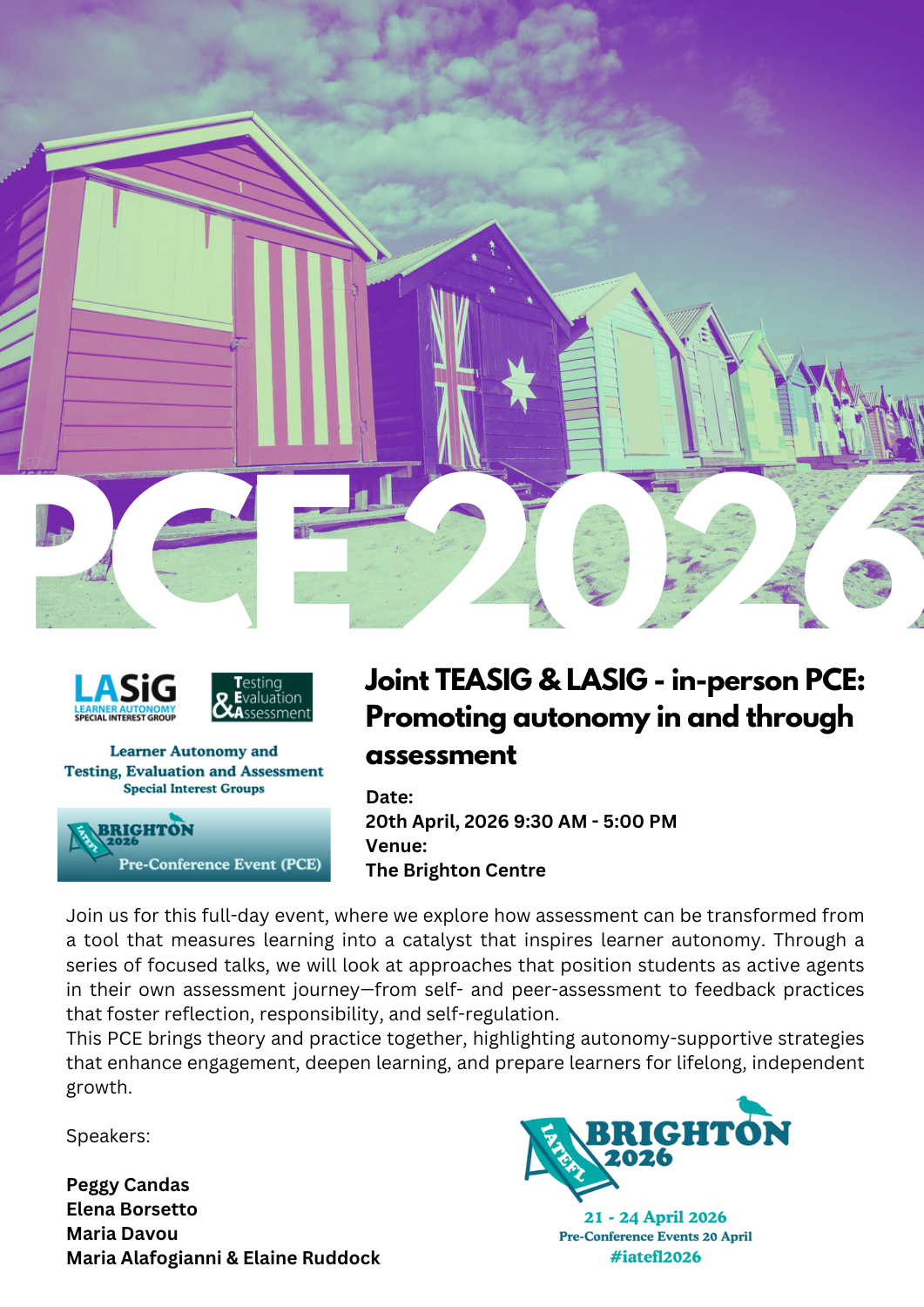
TEASIG & LASIG PCE 2026 Programme
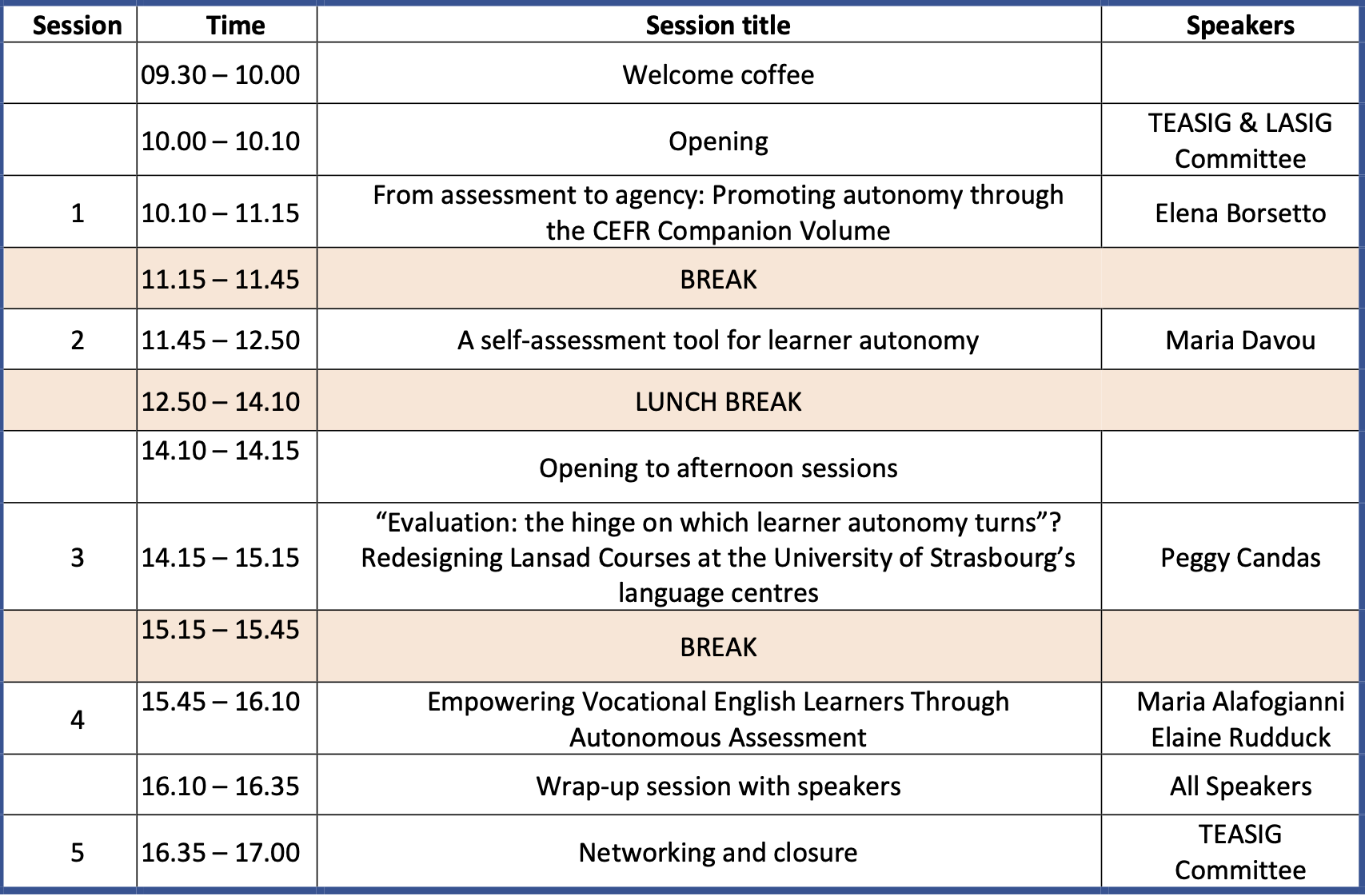
Session Details
Session 1
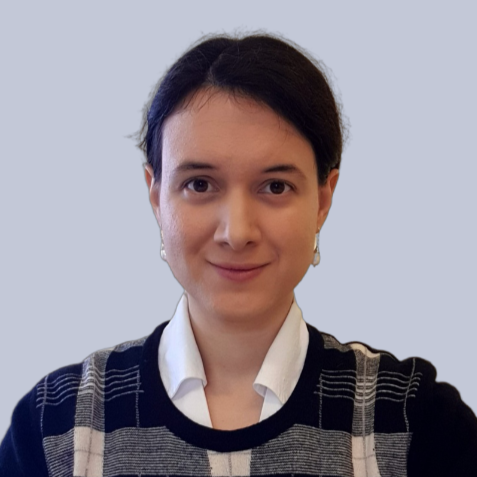 Elena Borsetto
Elena Borsetto holds a PhD in Educational Linguistics from Ca’ Foscari University of Venice, Italy. She is currently a postdoctoral researcher at the University of Verona, where she conducted a thematic analysis of the CEFR Companion Volume (2020) and related literature as part of a national research project entitled ‘European Language Centres: a multilingual community of practice. A multimodal analysis of scientific, cultural and social growth conveyed through the language of websites’. Elena also works as a teacher trainer and language consultant on professional development courses for academic staff, and she serves as an adjunct professor.
Title: From Assessment to Agency: Promoting autonomy through the CEFR Companion Volume
Abstract: Developing learner autonomy requires more than offering choices: it demands intentional assessment procedures that promote agency, self-awareness, and reflective engagement. This interactive workshop examines what current research tells us about autonomy and self-assessment, and discusses how the CEFR Companion Volume can assist with these processes. Building on the CEFR’s action-oriented approach, the session highlights how can-do descriptors can help learners and teachers make progress visible, identify meaningful goals, and take greater control of their learning pathways. Participants will be invited to reflect on how to integrate the descriptors into their teaching practices, to further include aspects such as reflection, critical thinking and self-regulation. Moreover, they will be prompted to consider their attitudes towards autonomy, and how these can shape classroom dynamics, as well as influence learners’ opportunities to act as agents in their own assessment and learning. The session aims to provide a set of ideas that can be adapted to different contexts, rather than a comprehensive model. Participants will leave with practical, CEFR-informed strategies that can be implemented gradually into their existing teaching routines to support learners’ lifelong autonomous learning.
Session 2
 Maria Davou
Maria Davou, born and raised in Athens, Greece, is a school owner, teacher, trainer, researcher, author, and storyteller. She holds a BA in Philosophy, Cambridge DELTA, an MA in TESOL, and has studied for a PhD in Applied Linguistics. With over 30 years of experience in teaching, teacher training, and syllabus design in Greece, the UK, and the US, she promotes alternative, experiential teaching approaches. Maria is an international trainer, adjunct professor at HAEC and the University of West Macedonia, co-founder of QUALIFY, founder of Glossobooks, and researches SLA, Critical Pedagogy, and Inquiry-based Learning.
Title: A self-assessment tool for learner autonomy
Abstract: In this talk, we will explore a self-assessment tool designed to promote learner autonomy, motivation, and sustained engagement in language learning contexts. The session introduces MPSA – My Photo Self-Assessment, an image-based, CEFR-aligned self-assessment routine that is implemented cyclically throughout the school year with learners aged 6–55. Drawing on visual prompts and reflective language use, MPSA encourages learners to evaluate their own progress in relation to communicative “can-do” statements rather than external grades or test results. Situated in a highly exam-centred educational context, MPSA aims to shift attention from performance outcomes to the learning process itself, fostering greater learner agency, metacognitive awareness, and intrinsic motivation. The talk outlines the pedagogical rationale behind the tool, its design principles, and the step-by-step classroom procedure, as well as teacher and learner perceptions gathered through informal feedback and classroom observation. Early findings suggest increased engagement, more meaningful reflection on learning, and a stronger sense of ownership over progress across age groups and proficiency levels. The session also discusses practical limitations and challenges, including time constraints, learner training, and the need for careful scaffolding. Finally, it considers how refining and adapting MPSA could further support learner autonomy, lexical development, oral fluency, and more learner-centred teaching practices across diverse educational settings.
Session 3
Peggy Candas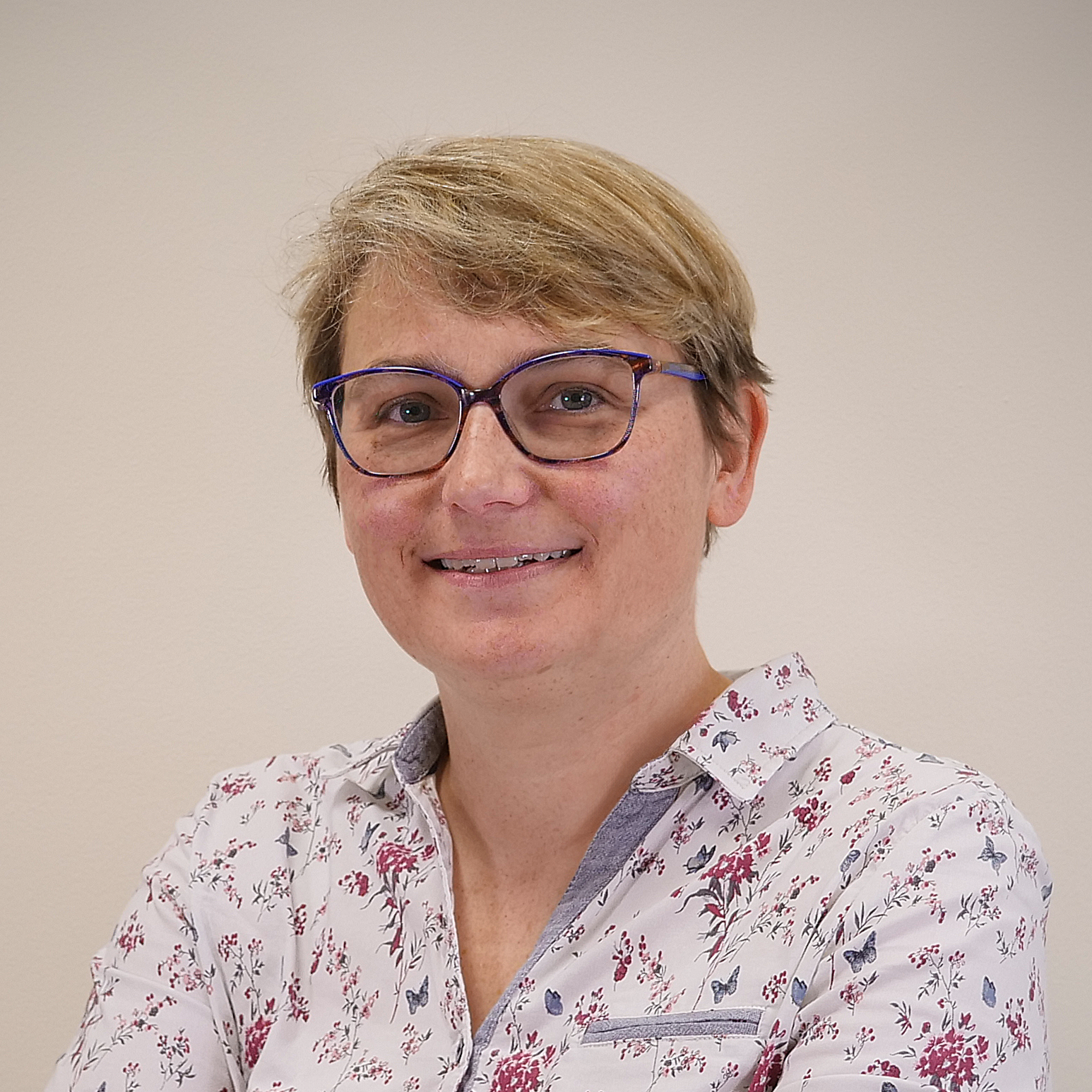
Peggy Candas is a lecturer in language didactics at the University of Strasbourg and the current deputy director of the research unit Linguistique, Langues, Parole (LiLPa, UR 1339). Her research focuses on learner autonomy and autonomisation, the support language teachers provide, and the obstacles that can hinder this process. Together with Pia Acker, she is in charge of the Pôle Lansad within the Faculty of Languages and has led the development of a new range of language courses for non-specialist students, based on a skills-based approach and assessment aligned with CEFR levels.
Title: “Evaluation: the hinge on which learner autonomy turns”? Redesigning Lansad Courses at the University of Strasbourg’s language centers.
Abstract: Strasbourg’s Pôle Lansad recently faced a key challenge: fostering learner autonomy in language courses while both teachers and students perceived traditional assessment as conflicting with this goal. Focus groups revealed significant concerns about grading practices, prompting the team to work with external experts to reconsider assumptions about assessment and its role in learning. This session outlines how the pedagogical and administrative teams jointly addressed this issue and redesigned their course structure. Over several years of training and reflection, they developed a new offer launched in September 2024: 20-hour courses, each centred on a specific communicative skill, such as defending a point of view in a debate, using academic sources, or presenting scientific work to a general audience. Traditional grades were removed and replaced with a final CEFR-based performance evaluation awarding ECTS credits. Attendees will gain insight into the strategies used to transition from grade-based to performance-based assessment, the institutional conditions that supported the reform, and the challenges that remain—particularly in balancing evaluation with learner autonomy. The session aims to provide practical, transferable ideas for institutions seeking to align assessment practices with their pedagogical objectives.
Session 4
 Maria Alafogianni
Maria Alafogianni studied English at the University of Westminster and Classical and Modern Greek Studies at King’s College London. She completed her CELTA at International House London and pursued postgraduate studies in ELT at Thames Valley University and the Chartered Institute of Linguists. She also holds an MSc in Counselling and Positive Psychology. With over 30 years of experience in the ELT field, Maria has worked as a tutor, teacher trainer, freelance translator, academic and career guidance counsellor, oral examiner, and coordinator for OFQUAL-regulated awarding bodies.
Elaine Rudduck
Elaine Rudduck is a seasoned professional with over 25 years of experience in training, assessment, and awarding. As Head of Standards at VTCT, she leads quality assurance, assessment, processing, and functional skills. She collaborates closely with education providers, industry partners, and government bodies to uphold rigorous standards across the sector. A strong advocate for communication skills, Elaine has made significant contributions to ESOL curriculum and assessment development, drawing on extensive expertise gained through both current and previous leadership roles.
Title: Empowering Vocational English Learners Through Autonomous Assessment
Abstract: In vocational English education learners need more than language knowledge, they must be able to use English autonomously in dynamic workplace contexts. This presentation focuses on promoting autonomy in and through assessment and explores how autonomous assessment practices can empower vocational English learners to take greater ownership of their learning. Drawing on classroom-based experience, it examines assessment approaches that actively involve learners as participants rather than passive recipients, including self and peer assessment, reflective learning tasks, portfolios, and authentic, task- based assessment linked to real workplace communication. The session highlights how transparent assessment criteria, negotiated goals, and feedback support learners in monitoring their progress, identifying learning needs, and developing self-regulation skills. Particular attention is paid to the role of the teacher in creating supportive assessment environments that encourage learner agency, confidence, and responsibility. The presentation also considers how autonomous assessment contributes to the development of skills such as critical thinking, reflection, and lifelong learning, which are essential in vocational and professional settings. Participants will explore practical ways to design assessment that empowers learners and enhances engagement in vocational English classrooms.Join TEASIG & LASIG in-person for this whole day event.
Fees:
Early Bird Prices – until 14 January
member price – 61.00 GBP
non-member price – 74.00 GBP
Standard Prices – registration after 14 January
Member standard price – 81.00 GBP
Non-member standard price -94.00 GBP
Online Registration for this event closes on the 8th April 2026, after this you will only be able to register at the event in Brighton- although capacity cannot be promised.
Important! Log in to your IATEFL account before booking your place: https://www.iatefl.org/user/login
Don’t have an IATEFL account? Create one for free here: https://www.iatefl.org/user/register
If you don’t log in and subsequently pay the wrong amount, an administration fee will be charged before refunds are processed.
Booking fees will increase to the standard rate for those delegates who book but do not pay by the early bird deadline.